|
Born in London, he was the youngest son of the Scottish Sculptor
William Mossman I
, and the brother of sculptors
John Mossman
and
George Mossman
. He worked primarily as an architectural and monumental sculptor in Glasgow, where he had settled with his family in about 1830.
He initially trained under his father before entering the London studios of
Marochetti
,
William Behnes, and
John Thomas
, for whom he produced
carving on the Houses of Parliament in London.
Thereafter, he collaborated with his brother John on several important sculpture
schemes for buildings in Glasgow, and worked independently as an architectural and
monumental sculptor in his own right.
He was frequently employed by the city's leading Gothic architect John Honeyman,
who's job books reveal Mossman's employment as a carver on several of his surviving ecclesiastical
buildings, such as:
Trinity Congregational Church, Berkley Street (1863, now Sir Henry Wood Hall), and
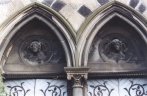
Lansdowne Church, Great Western Road, for which he carved the angel heads on the west front
more than a decade after the church was built (c. 1876).
Mossman worked with a number of assistants on his projects, including James Shanks, Alexander McGaw and William James Maxwell, with whom he worked on, respectively: Lansdowne Church; Kelvinside Parish Church (1862, now Oran Mor); and a church in Helensburgh for Honeyman.
It was after being impressed by Maxwell's work on the Helensburgh church that Mossman launched the career of the young sculptor by sending him to London with a letter of introduction to the eminent sculptor John Birnie Philip. Maxwell eventually became a prolific, though forgotten, architectural sculptor in Glasgow, London and Australia.
It was also around this time that Mossman suffered a terrible personal tragedy, when his six year old son, William, drowned after accidentally slipping into deep pond in an old brick field
in Byres Road in August 1864.
Much of William Mossman's secular work is concentrated in St. Vincent Place, where he was busy
on several projects for sculpture on commercial buildings throughout the 1870s.
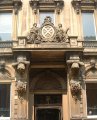
These inwere designed by important architects and include the Atlantes, heraldic group and keystone heads on J T Rochead's forme Bank of Scotland
(no. 2, now a pub) (1869); the reliefs of Sowing and Reaping on
John Burnet's Clydesdale Bank (nos. 30-40) (1871-4); and the reliefs and statues of
Justice, Truth and Amity on James Sellars' Scottish
Amicable Building (nos. 31-9) (1870-73, statues removed c. 1903).
Elsewhere in Glasgow, he executed the angel busts and carver work
on Eglinton Church, Eglinton Street, for John Burnet (1863, dem. 2000); the heads of John Knox, Ebenezer Erskine and Thomas Chalmers on The Albert Street UP Mission Church, McAslin Street, for J L Cowan (1871-2, dem. c. 1963); the figurative roundels on William Leiper's Partick Burgh Halls in Burgh Halls Street, illustrating ustice, truth and Mercy (1872), and the reclining classical figures representing Summer and Autumn on James Sellars' New Club, 14 West George Street (1877-9, now James Sellars House).
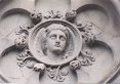
By this time he was well known and highly regarded as an architectural sculptor, and was often mentioned in the press for the quality of his work. Amongst the projects singled out by for praise by contemporary commentators (such as Thomas Gildard) were the now lost emblematic statues on the former Municipal Buildings in Ingram Street, of 1875-6, which were done in collaboration with his brother, John. These represented Britannia, The City Architect, Glasgow, The Lord Provost, and The Finisher of the Law. They also produced the building's armorial group featuring the city's coat of arms supported by a male figure representing the iron industry and a female representing the Textile Industry, which are also lost, and the roundel heads on the buildings Brunswick Street facade, the only part of the sculpture scheme to survive the building's alteration by its original architects, Clerk & Bell, in 1892.
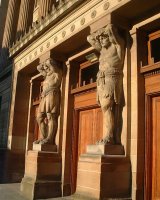
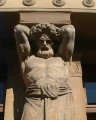
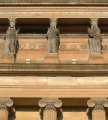
His largest recorded comission for architectural sculpture was for the Caryatids and Atlantes on the former St. Andrew's Halls, Granville Street (1873-7, now The Mitchell Theatre).
Working again with James Selllars as its designer, and in tandem with his brother John
and James Pittendrigh Macgillivray, who produced the building's colossal sculpture groups, he was responsible for modelling and carving the Atlantes at the building's main entrance, and the eight Caryatids which stand on the attics of the building's classical pavilions.
These were copied from the carytids by Phidias on the Porch of the Maidens on the ancient Erechtheum in Athens (421-404BC), but modified to hold attributes, such as a lyre or a model of the Parthenon's Doric portico, to represent various branches of the arts. The design for the doorcase was slso derived from an earlier, but more recent, model. This was based on the entrance features in Alexander 'Greek' Thomson's unsuccessful competition designs for the South Kensington Museum, London, of 1863.
Outwith Glasgow, Mossman's recorded works are rare. One identified example of his work is the coat of arms and carver work on the Town Hall, Campbeltown (1865-6).
He also taught modelling at the GSA
, from November 1869- 1871, during which time one of his most accomplished students was the sculptor
William Shirreffs
, and was active as a sculptor of portrait busts and wax medallions which he exhibited at the RGIFA
between 1862 and 1884. Amongst his clients for wax medallions was the architect John Honeyman and his wife, who's portraits he modelled by in 1877.
Mossman's links with monumental sculpture were also maintained throughout his career, either through working with his brothers in the family business on monuments for the city's Necropolis and cemeteries elsewhere in Glasgow and Scotland, or working on his own account or with others. He was briefly a partner in the family business when it traded as
J W & G Mossman
between 1853 and 1856, when he left to set up on his own. (It was then that his brothers changed the firm's name to
J & G Mossman
).
He later formed the partnership Mossman & Wishart with the Aberdeen based stonecutter and granite merchant, James Wishart (fl. 1870-98), which lasted from 1880 until 1884. The firm's Glasgow workshop was situated at 67 Stirling Road, and was overseen by Mossman, wihile Wishart oversaw their branch workshops in Aberdeen, at 35 Charles Street and 127 Causwayend. Wishart had previously formed short partnerships as Wishart & Dalgety, fl. 1870-1, and Milne & Wishart.
After Mossman's death in 1884, Wishart traded in Aberdeen with his son, as J. Wishart & Son,
at 1a Canal Street, and continued his Glasgow business as William Mossman & Co., until 1898.
The firm's Necropolis work includes the Celtic Cross to John Brown (1869), and the
monuments to Archibald Walker (1880, signed Mossman & Wishart) and Robert Spiers (1896).
Mossman was buried in Sighthill Cemetery, beside his father and brother, George.
Sources:
|